




Many people believe that the Viking Age was a male-dominated era. That armed men in warships called the shots, created kingdoms and plundered monasteries, while the women sat at home on the farm and spun yarn. Archaeology and the written sources show a different picture. Viking Age graves tell us that men and women had different symbols and roles, but that there were rich and powerful people of both sexes.
Viking Age women were regarded as more or less equal to the men. Women could be anything from housewife and priestess to head of the farm, merchant, craftsman, maid and so on.
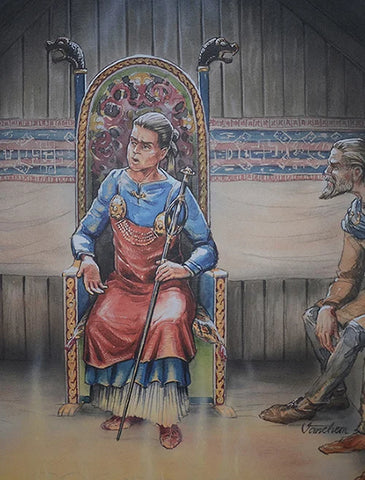
The woman in the picture, which comes from the Historical Museum, is called the ”mistress of Öland” because she was probably the leader of a wealthy Öland family based in Köpingsvik.
Some researchers believe that there were special female magicians.
Ceremonial staffs, like the one above, from Köpingsvik, may point to this. They are found in women's graves, while the written sources speak of female cult leaders such as Völur, which means staff bearers.
The Old Norse female cult leader was called a völva, which means staff bearer. The staff was used in seid, which among other things involved communicating with gods and other beings and predicting the future. It is therefore exciting that the woman was given a staff in her grave. She was probably a völva. Her staff is made of iron and bronze, and the little house on top of the staff is unique.
The staff shows her leading position in the Old Norse religion and is at the same time a clear aristocratic symbol.
Power over the center of the world.
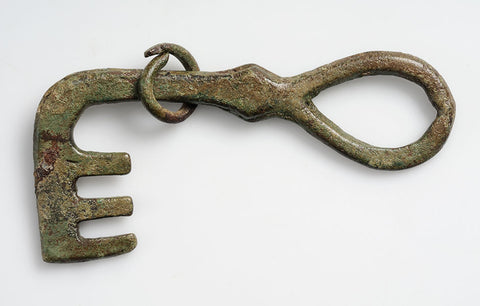
The Viking Age woman's position as mistress of the house meant that she was the obvious head of the farm and the household. This is evident from the fact that the key was one of her clearest symbols. Keys have been found in many Viking Age women's graves. Far into later times, the key symbolized power over the household. To a modern person this may seem like a kind of limitation. As if women had that responsibility instead of public power. But since the farm was the very center of the Viking Age world view, it should not be seen that way.
Runestone raisers
Women could pay for the raising of runestones. It was an outward-facing and public act of great importance. There are many stones where the inscriptions say they were raised by women.
Textile crafts
Textile tools are common in the women's graves. There are small whorls for the spindles they spun with, needles, scissors and sometimes wool combs or smoothers. With a smoother, linen could be made glossy.
The women of the sagas

Woman in a fine dress, with her hair put up and a drinking cup in her hand. Mount from Öland. Inventory no.: 128. Photo: Gabriel Hildebrand/SHM
Njal's saga was written in Iceland in the 13th century, but is based on a much older tradition. The saga is about feuds between the families of Gunnar and Njal. The saga seems to depict a male society, where the men's battles and quarrels dominate the story. But if you look more closely at the tale the men are really almost like puppets. The women steer the events in the background, but never take part in the fighting themselves. The bloodthirsty Hallgerd, for a time Gunnar's wife, manages to get two husbands, a foster father, and many others killed over trifles.
Source: The Historical Museum.
Cover photo: Madeleine Arkona Åberg and Lilly Molin Norlin on the horses Armani and Goliat from Hästravaganza. Photo: Jenny Wande