






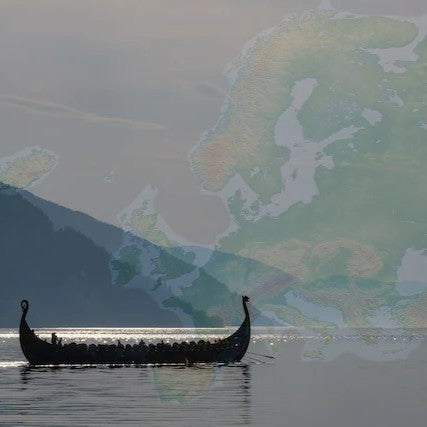
The Viking Age, stretching from the 9th to the 11th century, is a fascinating period in Scandinavian history. But did you know that the Vikings' adventures also took them to Ukraine and Russia? This article explores how these Scandinavian warriors and traders influenced and were influenced by the East Slavic peoples in these regions.
During the 9th century, the Vikings began exploring and trading along rivers flowing from Scandinavia to the Black Sea. These routes, which included the Dnieper, Volga, and Don, made it possible for them to reach as far as the Byzantine Empire and the Caliphate of Baghdad.
One of the most famous Vikings who also played a crucial role in the East Slavic regions was Rurik. He founded the Rurik dynasty in 862 and became ruler of the newly established city of Novgorod. Rurik's descendants would later form a long line of princes and rulers who governed Russia and Ukraine.
In 882, Rurik's descendant Oleg of Novgorod conquered the city of Kiev and created Kievan Rus', which became a powerful state over the following centuries. It was during this time that the Vikings became an integral part of Russia's and Ukraine's history. They intermarried with local women, converted to Christianity, and learned Slavic languages and cultures.
Vladimir the Great, another prominent figure from this era, is a symbol of this cultural blending. He ruled over Kievan Rus' from 980 to 1015 and married Anna, the sister of Byzantine Emperor Basil II. Through his marriage to Anna, Vladimir converted to Christianity and brought the new faith to his realm, leading to a mass conversion of the population in Kievan Rus'.
After the death of Vladimir the Great, the Vikings gradually began to assimilate into East Slavic societies. They lost their unique identity but left a lasting legacy in the form of blended cultures and genetic traits. The Vikings' presence also had a significant impact on the development of trade, urban planning, and military strategy in the area.
But how did the Vikings' journeys to Ukraine and Russia affect Scandinavia? There are theories that Vikings returning from the east brought back new trade goods and knowledge, including techniques for metalworking and weapon manufacturing, which were then used to enhance Scandinavia's military power. The Vikings' presence in the east may also have contributed to the spread of Norse mythology, where the gods Odin, Thor, and Freyja played a central role.
Although the Vikings' presence in Ukraine and Russia is less known than their journeys to Western Europe, their history in the east should not be underestimated. Their successes as warriors and traders, their intermarriages, and their assimilation into East Slavic societies have left a permanent mark on the region's history and culture.